Wednesday, April 30, 2014

Kangaroo Farts Reduce Global Warming !


We are all familiar with cows and how they produce the majority of methane gas in the atmosphere that causes global warming. But not all animals produce farts that release large amounts of methane. In a recent study researchers discovered that kangaroos are different. They are special because unlike cows their farts contain less methane than cows, and this is due to a distinct mixture of microbes that are located in the kangaroo’s gut. The study found that the reason cows produce so a lot of methane is the majority of microbes in the digestive tract were methanogens, which are methane producing microbes. But among the kangaroos the microbes they contained were acetogens, which produce a substance called acetate. What was interesting was that both the cows and the kangaroos had a combination of the methanogens and acetogens, but why was it that in cows the methanogens outnumbered that acetogens and produced more methane and why in kangaroos were there more acetogens and few methanogens to produce more acetate and less methane. This is what the puzzled the research team and this is what they need to focus on. This study is very important because it could lead to cutting methane emissions from farm animals to slow down the affects of global warming. This article was very informative and interesting and the author did a good job of explaining it, the author wrote in humorous tone, which helps keep the reader interested and there was glossary at the end that was very useful for some of the vocabulary. 
https://student.societyforscience.org/article/kangaroos-have-green-farts

Wednesday, April 23, 2014

Gender Biased Microbes

http://www.uc4life.com/images/hormones.jpg
A new study has found that microbes cooperate with sex hormones to affect the immune system. This new study found that males and females have slightly different immune systems and this all has to do with certain gut microbes that are present in each gender. Females are able to mount a more powerful immune response to attacks than males. But this enhanced protection of the immune system in females has a flipside; it puts them at a greater risk of autoimmune disorders. The study also discovered that certain microbes prevalent in males could actually protect them from type 1 diabetes. In the study the researchers mentioned that this study has shed light on a topic that has not been studies much. "The gender bias in major autoimmune diseases is well known but not well understood," said Alexander Chervonsky of the University of Chicago, who also heads the research team. Although this research was a breakthrough and until now it wasn’t clear how the microbes and the sex hormones work together to influence gender bias in autoimmune diseases like type 1 diabetes. To understand this more the researchers studied microbial communities in mice. They were looking for differences in the males and females and found that the microbes became different once the mice reached puberty. With these results the researchers suggested that sex hormones contributed to gender-specific changes in the gut microbes. The authors article was very descriptive but was lacking some information that could have made a positive contribution to the article. The author could have mentioned which microbe it was that is different among the males and the females. But other than that it was fascinating to learn that males and females have slightly different immune systems because of gut microbes that each gender has.

Wednesday, April 16, 2014

E. coli To the Rescue.


http://images.sciencedaily.com/2013/10/131002125505-large.jpg
The bacteria E. coli is mostly known for making people sick and has always received a bad reputation. But most people don’t seem to know that E. coli is a regular inhabitant of the gut and actually benefits the host by producing vitamin K, and now scientists have discovered that they can reprogrammed the microbe to seek out and kill other disease-causing pathogens. This programmed type of E. coli can even kill bacteria within biofilms, which are responsible for many infections. We have previously learned in class about biofilms and how they can form within our bodies as well, some places where they can form is on your teeth and on medically implanted devices and this can lead to some serious infection if not treated promptly. Which is why this discovery can potentially be life saving, because the bacteria that cause these infections live in well-developed biofilms. In the study the researchers programmed the bacteria to sense Pseudomonas aeruginosa, a bacteria that can form biofilms and cause hospital acquired infections in the lungs and the gut. The E. coli swims to the Pseudomonas aeruginosa and kills it by releasing an antimicrobial peptide and an enzyme that is able to breakdown biofilms. This article was very interesting and the discovery has a lot of potential if it can be applied to the dental field because of the biofilm on teeth that cause cavities and gum diseases. In the entire article only one researchers name was mentioned, it did not mention who or what he does, which makes the article seem questionable but overall it was still quite interesting.
http://www.sciencedaily.com/releases/2013/10/131002125505.htm

Wednesday, April 9, 2014

Beneficial Bacteria

http://images.sciencedaily.com/2014/03/140312132632-large.jpg
Our relationship with microbes is complicated; some make us sick but some help out our immune system. But Caltech professor of biology and biological engineering Sarkis Mazmanian recently discovered in a study that beneficial gut bacteria were necessary for the development of specialized white blood cells, that serve as the body’s first line of defense against pathogens. The study looked at the immune cell population in germ-free mice, which are mice born with gut bacteria, and in healthy mice with a normal population of gut microbes. In the study the researchers discovered that the healthy mice had more immune cells than the germ-free mice, which makes them better able to fight off infections. They also discovered that the germ-free mice had fewer granulocyte and monocyte progenitor cells, which are cell that eventually develop into a few types of mature immune cells.  The researchers tested to see if the mouse with a reduced amount of immune cells was able to fight off infection as well as the healthy mice. So they injected the mice with Listeria monocytogenes, the healthy mice were able to fight off the infection and recuperate but the infection was fatal to the germ-free mice. The research suggests that a healthy population of gut microbes can provide a alternative to antibiotics.What is really interesting about this study is that what is causing all these affects are the gut microbes; they are affecting areas like blood, spleen, and bone marrow, which are places where there shouldn’t be any bacteria.
http://www.sciencedaily.com/releases/2014/03/140312132632.htm

Wednesday, April 2, 2014

Killer Microbe


http://images.sciencedaily.com/2014/03/140325133548-large.jpg
Pulling weeds out from your lawn can be a hassle and they always seem to grow back no matter how many times you pull them or even if you spray them, the spray can also be harmful. But researchers have now discovered that some microbes in the soil can actually prevent certain weeds from growing by having a microbial community in the roots that will kill the ragweed. Lead researcher was microbial ecologist Tony Yannarell from the University of Illinois, used high-power DNA fingerprinting tools to study all the microbes in the soil, by doing this he was able to identify those microbes that both preferred ragweed and affected its growth. Throughout the year we have been learning about microbes that have a symbiotic relationship with plants, but now they discover some of these relationships are parasitic. Although one might think that it is as simple as adding anti-ragweed microbes to the soil to prevent the weeds from growing but its not, Yannarell said “adding microbes to soil hasn't been successful in the past” so it is a bit more complicated. In order to be able to grow colonies of microbes that prevent ragweeds from growing there has to be certain types of other plants that have those microbes in the roots. This study yielded some interesting results but it looks like they have to study the microbes in order to better understand them and to be able to use them as a weed-suppressant. This article was really interesting and if the researchers were able to develop these anti-ragweed microbes then it would be very beneficial because it would eliminate the need for harmful sprays. One thing that the article could have changed is actually mentioning what microbes that they studied, this would give us a better insight and help us better understand it.
http://www.sciencedaily.com/releases/2014/03/140325133548.htm

Wednesday, March 26, 2014

Skin Microbes


The Human Microbiome is the collection of microbes living in and on our bodies, the number of microbes greatly outnumber the amount of human cells in the body. Since there are so many microbes in our bodies we are always constantly learning new things about the microbes that inhabit our bodies. In this article researchers discovered that our immune system influences the types of microbes that live on our skin and thus potentially prevents disease. This meaning that the immune system of a healthy person will harbor different types of bacteria and fungi on the skin, compared to people with primary immunodeficiencies with eczema-like skin conditions. The study observed patients with reduced immune function as a result of rare genetic defects, in which they all had an eczema-like skin condition and compared them to healthy individuals to see what type of bacteria and fungi are growing. They concluded that the immune system plays a major role in dealing with what types of microbes your skin has, and that patients with the skin condition have different types of microbes present. In the study they also found that different areas of the body tend to have more or less microbes depending on the area. For example the skin at the elbow crease has very few microbes compared to the skin behind your ear. Although this article was interesting it was hard to follow and understand all the details. They also did not mention specific ways in which the study can actually help patients with the rare genetic disorders, they just gave a brief explanation that this research may have implications, which left me curious and with some unanswered questions. 
http://www.sciencedaily.com/releases/2013/10/131029133542.htm
Patient with an eczema-like skin rash.
http://images.sciencedaily.com/2013/10/131029133542-large.jpg

Wednesday, March 12, 2014

Immortal MIcrobes !


Do you sometimes wish that you could stay young forever? I know I do. But aging is a part of life and is inevitable. But this is not that case of a common species of yeast microbe, which has actually evolved to stay young. Researchers from the University of Bristol and Max Planck Institute have discovered this microbe that stays forever young by rejuvenating every time it reproduces. The team showed that the yeast microbe called S. pombe is immune to aging when it is reproducing under favorable growth conditions. The way this works is by the yeast has to keep dividing fast enough, but also there are mechanisms in place that ensure that one half gets older and defective cell material, while the other half gets newly formed cell material which keeps it young. This is just like in humans, in a sense, that they produce offspring that is younger than the parent; but its different than in other microbes that split into two pretty equal halves. This all works perfectly under the right conditions, but the researchers also wanted to see if this still applied when the conditions were not so favorable. So the research team exposed the S. pombe to heat, ultraviolet radiation, and damaging chemicals, which affected the microbe growth so it could no longer stay young, and once exposed to these conditions the yeast cells began splitting into a younger and older half just like other cells. The researchers also stated that these findings could “potentially serve as a model of certain non-aging types of cells in humans”. It is amazing to learn that even microscopic organisms evolved powerful strategies to survive. Although this article was interesting it did not go into how exactly this could serve as a model of non-aging types of cells in humans. That left me wondering, how exactly cans this discovery help humans.
http://www.sciencedaily.com/releases/2013/09/130912132005.htm
http://images.sciencedaily.com/2013/09/130912132005-large.jpg

Wednesday, March 5, 2014

Microbe Sex !


http://images.sciencedaily.com/2014/01/140103204500-large.jpg
Microbes have sex! Sounds pretty crazy right? Not according to a new study. Researchers from the University of Bristol have for the first time observed microbes mating. The microbes that were caught in the act belong to a strange group of protozoa. Trypanosomes are the cause of the tropical disease African sleeping sickness. African sleeping sickness causes fever, headaches, itches, and joint pains in the first stage of the sickness, and then in the second stage the parasites invade the central nervous system and disrupt the sleeping cycle which leads to trouble sleeping and that’s were the name comes from. The research teams were able to observe the microbes twirling together before they formed into one hybrid cell. And according to the scientists sex matters for the microbes because it enables them to swap genes between the different strains. Although it is really important for the microbes it can also be potentially be dangerous. This is due to a lot of harmful genes can be combined into one strain, which leads to drug resistant strains to develop. Before this discovery scientist believed that these microbes reproduced by splitting in half by binary fission.
This article was very interesting but was very brief and did not contain much scientific facts, it was like the icing on the cake. It could have gone more into depth and provide more background information about the parasite. This new information opened my eyes about protozoa and microbes; I had no idea that microorganisms had sex.
http://www.sciencedaily.com/releases/2014/01/140103204500.htm

Wednesday, February 26, 2014

Virus Cures Cancer


http://www.alnmag.com/sites/alnmag.com/files/legacyfiles/u1238/virus_0.jpg
As some people may know skin cancer is the most common cancer in the United States. Skin cancer is divided into two types, non-melanoma and melanoma categories. Around two million new cases are diagnosed each year, about 5 percent of these cases are melanoma skin cancer, which is more serious and cause about 75% of skin cancer deaths. But researcher from the Yale University School of Medicine have demonstrated that vesicular stomatitis virus (VSV) can actually find, infect, and kill human melanoma cells, without infecting the non-cancerous cells in animal test subjects. The study was done on a mouse, which was implanted with deadly human melanomas. The virus was able to selectively infect the cancer causing cells, and showed little to no infectivity toward the normal healthy cells. The hypothesis is that most normal cells resist viral infections by activating the antiviral process that protects nearby cells, but cancerous cells show a deficient ability to withstand virus infection. Which is why maybe fast acting virus like the VSV would be able to infect and kill cancer cells. “If it works as well in humans, this could confer a substantial benefit on patients afflicted with this deadly disease,” says Anthony van den Pol, a researcher on the study. This could lead to further advancements in the study of not only just skin cancer but also other more sever forms of cancer, and also the development of new treatments. Since melanoma is the most deadly skin cancer and is incurable once they have metastasized into the body it is important to explore ways to combat and prevent it. 
http://www.sciencedaily.com/releases/2013/04/130423135710.htm

Wednesday, February 19, 2014

Ants and Fungus ?


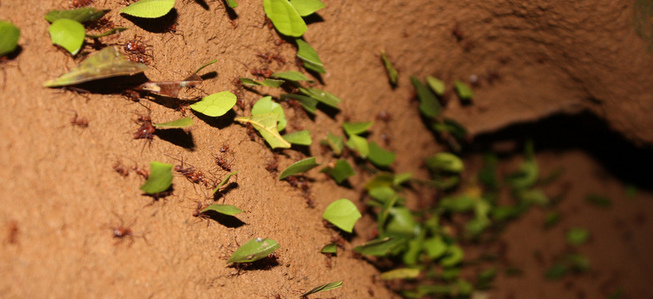
One of the few things that I knew about fungi before coming into this class was that, leaf-cutting ants and fungus had a symbiotic relationship. In this mutually beneficial symbiosis the ants cultivate fungus gardens, which provides a safe home for the fungi and also a food source for the ants. But this symbiotic relationship also includes microbes. And new research has discovered that it can help speed the development of better antibiotics and biofuels.
https://microbewiki.kenyon.edu/images/6/65/Leafcolony.jpg
Ten years ago Cameron Currie a microbial ecologist at the University of Toronto in Ontario, Canada, was studying the symbiosis relationship between the leaf-cutting ants and the fungus. He discovered that ants carried colonies of actinomycete bacteria on their bodies. These bacteria in turn make an antibiotic that protects the ants’ fungal crop from parasitic fungi such as Escovopsis, which threatens the ants’ food source and is a constant danger for the ants.
Currie and Jon Clardy at the Harvard Medical School and their colleagues also reported that they had isolated one of the antifungals produced by the bacteria. The antifungal slowed the growth of a drug-resistant strain of the fungus Candida albicans, which causes yeast infections in people. With these discoveries the researchers hope that they will learn how to make better antibiotics by studying the bacteria and how they have adapted to fight off the parasites.
Although these discoveries seemed to have much potential it didn’t get much attention or support after that. These studies were from 1999, but no further updates were added, which left me wondering why they didn’t continue. 
http://www.nature.com/news/2009/090329/full/458561a.html

Thursday, February 13, 2014

Office Bacteria !


It is no secret that women are generally more hygienic than men. For the most part this is true, but a new study has found that men’s offices have more bacteria than woman’s offices. The study looked at 90 offices in three cities, New York, San Francisco, and Tucson. They looked at five types surfaces: chairs desktops, phones, keyboards, and computer mice. The author of the study, Scott Kelley, said, “It could also be that men are less hygienic”. The total bacterial count in men’s offices was anywhere from 10 to 20 percent greater than in women’s offices. Dr. Kelley also said “It was fairly uniform across all of the samples,” meaning that in the there was little difference between the three cities in which the study was conducted. Most of the bacteria found in the offices can actually be traced back to the human mouth and skin, meaning that people are the main source of the bacteria in the offices. Dr. Kelley also emphasizes that the study is not meant to cause alarm and there is no reason to worry, the study was simply done to show us the day-to-day-environment that most of us live in. Although this article was interesting, it was of no real significance. The study was done to simply show us the environments of everyday life. Also the article failed to mention what type of bacteria was found in the office buildings; which further emphasizes that the bacteria are not significant but are only to show that men’s offices contain more bacteria than woman’s. 
http://www.nytimes.com/2012/06/05/science/mens-offices-have-more-bacteria-study-finds.html?ref=science&_r=0
http://graphics8.nytimes.com/images/2012/06/05/science/05OBBACTERIA/05OBOX2-articleLarge.jpg